CIMA F2 Course

Uncategorized
Wishlist Share

About Course

This comprehensive CIMA F2 (Advanced Financial Reporting) course has been designed to provide you with everything you need to master the syllabus, build confidence, and pass your examination on your first attempt. Whether you are studying the subject for the first time or preparing for a resit, this course offers a structured, exam-focused learning experience that covers every topic in the CIMA F2 syllabus in a clear, practical, and easy-to-follow manner.

Each chapter is explained in detail through professionally prepared lecture notes and high-quality pre-recorded video lectures, enabling you to develop a thorough understanding of advanced financial reporting principles and their practical application. The course covers complex accounting standards, group financial statements, financial instruments, and analytical techniques while equipping you with the technical competence and exam skills required to succeed.

Choose this course if you want a complete, all-in-one resource to master the CIMA F2 syllabus and maximise your chances of passing at your first attempt.

What you’ll receive in this course:

  • ✅ Comprehensive lecture notes for every chapter, covering the entire CIMA F2 syllabus.
  • Pre-recorded video lectures for every chapter, allowing you to study at your own pace and revisit complex topics whenever needed.
  • ✅ Professionally prepared chapter presentation slides to reinforce learning and support effective revision.
  • Flashcards summarising key accounting standards, principles, calculations, and examinable concepts for quick revision.
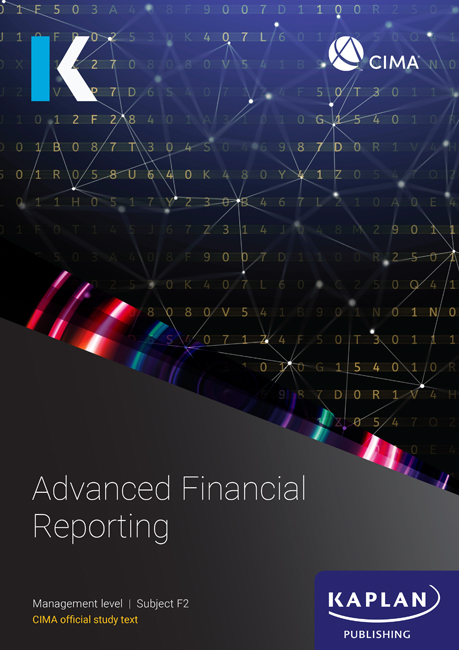
  • ✅ The Kaplan Study Text, providing detailed explanations, worked examples, and comprehensive syllabus coverage.
  • ✅ The Kaplan Exam Practice Kit, containing exam-standard questions and fully worked solutions to strengthen your exam preparation.
  • ✅ Step-by-step explanations of advanced financial reporting concepts, including consolidated financial statements, IFRS requirements, financial instruments, leases, revenue recognition, and financial statement analysis.
  • ✅ Exam-focused guidance and proven techniques for answering objective test questions accurately and efficiently.
  • ✅ Structured learning resources designed to build confidence, strengthen technical competence, and prepare you thoroughly for your examination.
  • ✅ A complete learning package that supports you from your first study session through to exam day.

This course is ideal for students who want a comprehensive, well-structured, and high-quality learning experience with all the resources needed to successfully complete the CIMA F2 (Advanced Financial Reporting) examination.

Show More

Course Content

Chapter 1: Long-Term Finance
This chapter introduces the sources and principles of long-term finance used to support an organisation's strategic growth and investment objectives. You will explore equity finance, debt finance, lease finance, and other long-term funding options, while evaluating their advantages, costs, and impact on capital structure. The chapter also examines how financing decisions influence financial performance, shareholder value, and long-term organisational sustainability.

  • Learning objectives, Background and Introduction
  • Part A
  • Part B
  • Part C
  • Part D

Chapter 2: Cost of Capital
This chapter explores the concept of the cost of capital and its importance in financing and investment decisions. You will learn how to calculate the cost of debt, equity, and preference shares, as well as the Weighted Average Cost of Capital (WACC), and understand their application in business valuation and capital investment appraisal. The chapter also explains how the cost of capital influences strategic financial decision-making and the maximisation of shareholder value.

Chapter 3: Financial Instruments
This chapter introduces the classification, recognition, measurement, and disclosure requirements for financial instruments in accordance with relevant accounting standards. You will learn how to account for financial assets, financial liabilities, derivatives, and equity instruments, while understanding their impact on financial statements. The chapter also explores the role of financial instruments in risk management, financing, and financial reporting.

Chapter 4: Earnings Per Share (EPS)
This chapter explores the calculation and reporting of Earnings Per Share (EPS) in accordance with the relevant financial reporting standards. You will learn how to calculate basic and diluted EPS, account for changes in share capital, and understand the impact of potential ordinary shares on reported earnings. The chapter also highlights the importance of EPS as a key performance measure used by investors and other stakeholders in assessing an organisation's financial performance.

Chapter 5: Leases (Based on IFRS 16: Leases)
This chapter examines the accounting requirements of IFRS 16: Leases, focusing on the recognition, measurement, presentation, and disclosure of lease transactions. You will learn how to account for leases from both the lessee's and lessor's perspectives, including the recognition of right-of-use assets and lease liabilities. The chapter also explores the impact of lease accounting on financial statements, performance measures, and key financial ratios.

Chapter 6: Revenue from Contracts with Customers (IFRS 15)
This chapter explores the principles of IFRS 15: Revenue from Contracts with Customers, focusing on the recognition, measurement, and reporting of revenue. You will learn how to apply the five-step revenue recognition model to a range of contractual arrangements, including contracts with multiple performance obligations. The chapter also examines the impact of revenue recognition on financial reporting and ensures compliance with the requirements of IFRS 15.

Chapter 7: IAS 37 – Provisions, Contingent Liabilities & Contingent Assets
This chapter examines the requirements of IAS 37 for recognising, measuring, and disclosing provisions, contingent liabilities, and contingent assets. You will learn how to distinguish between these items, determine when recognition is appropriate, and apply the relevant accounting principles in practice. The chapter also highlights the importance of accurate reporting to ensure that financial statements present a true and fair view of an organisation's financial position.

Chapter 8: Intangible Assets
This chapter explores the accounting treatment of intangible assets in accordance with the relevant financial reporting standards. You will learn how to recognise, measure, amortise, and assess the impairment of intangible assets, while distinguishing between internally generated and acquired assets. The chapter also examines the disclosure requirements and the impact of intangible assets on an organisation's financial statements and performance.

Chapter 9: Income Taxes (IAS 12)
This chapter examines the accounting requirements of IAS 12: Income Taxes, focusing on the recognition and measurement of current and deferred tax. You will learn how to identify temporary differences, calculate deferred tax assets and liabilities, and account for the tax effects of transactions and events. The chapter also explains how income tax is presented and disclosed in the financial statements in accordance with IFRS requirements.

Chapter 10: Foreign Currency Transactions (IAS 21 – The Effects of Changes in Foreign Exchange Rates)
This chapter explores the accounting requirements of IAS 21: The Effects of Changes in Foreign Exchange Rates, focusing on the recognition and translation of foreign currency transactions and balances. You will learn how to account for exchange differences, determine functional and presentation currencies, and translate foreign operations into the reporting currency. The chapter also examines the impact of foreign exchange movements on financial statements and ensures compliance with IFRS reporting requirements.

Chapter 11: Group Accounts – Subsidiaries (Consolidated Statement of Financial Position)
This chapter introduces the principles of group accounting and explains how to prepare a Consolidated Statement of Financial Position (CSOFP) for a parent and its subsidiaries. You will learn how to account for acquisitions, non-controlling interests, goodwill, and intra-group transactions in accordance with IFRS requirements. The chapter also develops the skills needed to produce accurate consolidated financial statements that present the financial position of the group as a single economic entity.

Chapter 12: Group Accounts – Subsidiaries (Consolidated Statement of Profit or Loss and Other Comprehensive Income)
This chapter examines the preparation of the Consolidated Statement of Profit or Loss and Other Comprehensive Income (CSPLOCI/CSOPLOCI) for a group of companies. You will learn how to consolidate the financial performance of a parent and its subsidiaries, account for non-controlling interests, eliminate intra-group transactions, and calculate group profits. The chapter also develops your ability to prepare IFRS-compliant consolidated financial statements that accurately reflect the performance of the group as a single economic entity.

Chapter 13: Group Accounts – Associates & Joint Arrangements
This chapter explores the accounting treatment of associates and joint arrangements in accordance with the relevant IFRS standards. You will learn how to apply the equity method, distinguish between associates and joint arrangements, and account for investments in group financial statements. The chapter also explains how these investments are recognised, measured, and presented to ensure accurate and IFRS-compliant consolidated reporting.

Chapter 14: Consolidated Statement of Changes in Equity (CSOCIE)
This chapter examines the preparation of the Consolidated Statement of Changes in Equity (CSOCIE) in accordance with IFRS requirements. You will learn how to account for movements in share capital, retained earnings, reserves, and non-controlling interests, while reflecting changes arising from group transactions and comprehensive income. The chapter also develops your ability to prepare an accurate CSOCIE that presents the changes in the equity of a group as a single economic entity.

Chapter 15: Consolidated Statement of Cash Flows
This chapter explores the preparation of the Consolidated Statement of Cash Flows for a group of companies in accordance with IFRS requirements. You will learn how to classify and report operating, investing, and financing cash flows, while accounting for acquisitions, disposals, and intra-group transactions. The chapter also develops your ability to prepare a consolidated cash flow statement that accurately reflects the cash movements of the group as a single economic entity.

Chapter 16: Foreign Subsidiaries
This chapter examines the accounting treatment of foreign subsidiaries and the translation of their financial statements into the parent company's presentation currency in accordance with IAS 21. You will learn how to determine functional currency, translate assets, liabilities, income, and expenses, and account for foreign exchange differences arising on consolidation. The chapter also explains how foreign operations are incorporated into group financial statements while ensuring compliance with IFRS reporting requirements.

Chapter 17: Related Party Disclosures
This chapter explores the disclosure requirements of IAS 24: Related Party Disclosures, focusing on the identification of related parties and the reporting of transactions between them. You will learn which relationships and transactions require disclosure, the information that must be presented in the financial statements, and the purpose of these disclosures in promoting transparency. The chapter also highlights how proper related party reporting enhances the reliability, comparability, and integrity of financial statements.

Chapter 18: Integrated Reporting
This chapter introduces the principles of Integrated Reporting () and explains how organisations communicate value creation through both financial and non-financial information. You will explore the Integrated Reporting Framework, the six capitals, guiding principles, and content elements that support transparent and sustainable corporate reporting. The chapter also highlights how integrated reporting enhances stakeholder decision-making by providing a holistic view of an organisation's strategy, governance, performance, and long-term value creation.

Chapter 19: Analysis of Financial Statements
This chapter explores the techniques used to analyse and interpret financial statements for effective decision-making and performance evaluation. You will learn how to apply ratio analysis, trend analysis, cash flow analysis, and other analytical tools to assess an organisation's profitability, liquidity, efficiency, and solvency. The chapter also develops your ability to interpret financial information and provide meaningful insights to support strategic business and investment decisions.

Student Ratings & Reviews

No Review Yet
No Review Yet
Back to Top